I was on a job recently where I had to completely rework the entry door install on a house. Information technology was difficult to tell from a distance, but the original work had been poorly done (and that might be an understatement!). All of the errors fabricated in that original installation became more and more apparent once I started disassembling the install in order to right the wrongs. Sometimes you take to peel back more than than the skin to see how rotten the fruit is at the core. And then you lot demand to accept a strategic approach to help that cadre heal.
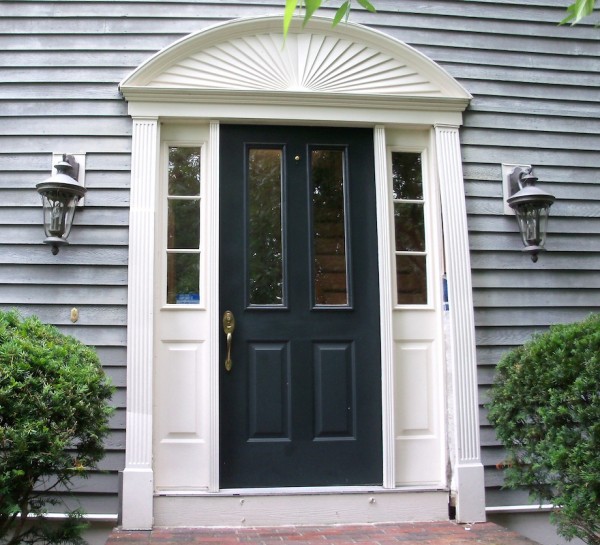
The original rotten door entry (Note: Click whatsoever epitome to enlarge)
Peeling the Layers
We started by removing the side casings. This is where we encountered our first upshot.
Removing the casings revealed improper weather barrier installation—no flashing was practical (see photos below). On tiptop of that, one of the sides was missing a section of housewrap, leading to rotten sheathing. There was also rot at the bottom corner of the opening.
Of course, if flashing had been incorporated with the housewrap, these bug could have been prevented.
| When I removed the pediment, I found that there was another section of housewrap missing; fortunately the damage was superficial and small-scale. | 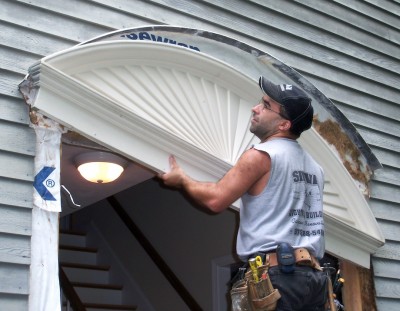 |
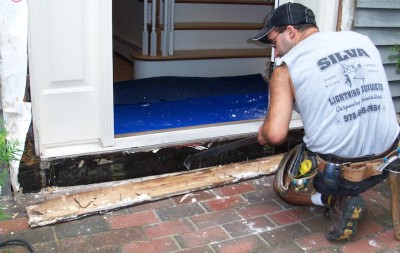 | One of my biggest issues at this indicate was that the door riser was sealed to the concrete landing. Whenever I see this (and I ofttimes do), I always expect to see some rot. I never know how much. |
In this case, past sealing the bottom, water had become trapped behind the trim, causing damage to the sheathing and to the rim joist, which was badly rotted.
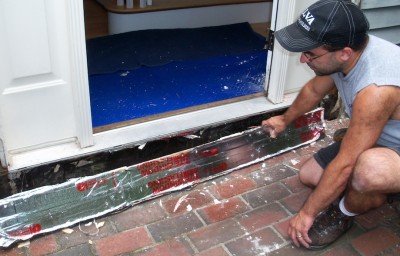 When I removed the casings I had noticed the bottom corners were jutting out about 1 inch. Afterward removing the riser, forth with the rubber flashing, I found that someone had attempted a repair, just they only made matters worse! They had practical a 1-in. thick insulation lath to the structure, farther trapping water at the corners.
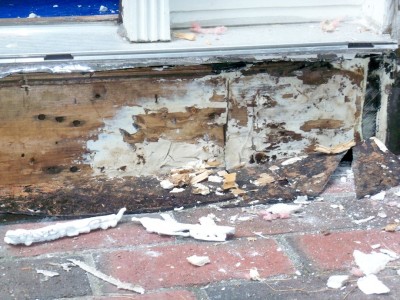 | I as well discovered that when they removed the existing riser, they filled in the rotten capsule with cream insulation, trapping even more water against the rim joist! |
| My adjacent stride was to remove the door unit. I had to pry off the safety flashing from the top of the lesser opening. | 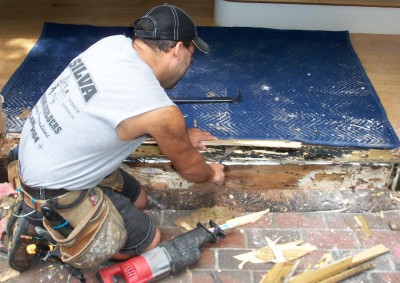 |
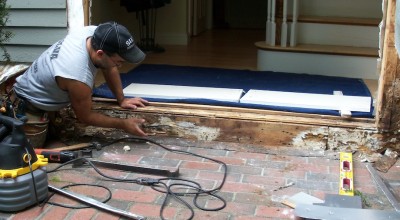 | Afterward closely examining the lesser of the door opening, I constitute that they had added a piece of iii/4-in. plywood over the sub floor in order to raise the door. At this point, I just removed the rotten slice. |
I poked at the rim joist when I removed the sheathing and constitute that it also had to be replaced.
I then removed some more capsule on both sides in gild to cutting the rim joist at a solid department.
| To remove the damaged section, I cutting both ends and removed all the nails securing it. In order to remove the rim joist, which was pinned behind the stoop, I snapped off half of the board's width. The other half was behind the stoop, so I ran a sawzall behind the board to cut all the nails. | 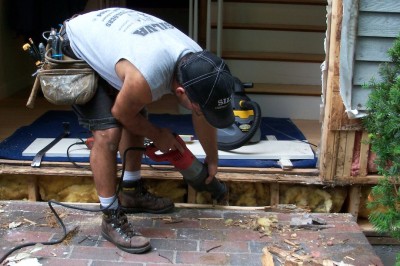 |
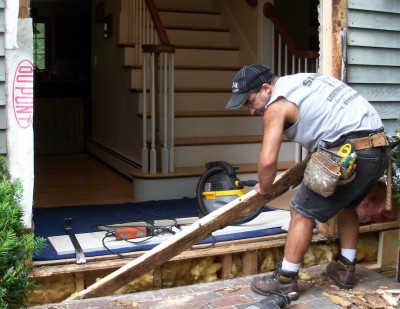 | The board then slid out very hands (boy, don't you just love that!?). |
| I should mention that information technology'due south always a good thought to clean upwards later on every phase of the job. Cleaning equally you work will help you get better results, and it'll improve your mood, too—working with rotten wood isn't exactly fun, only keeping the site clean and organized sure helps. | 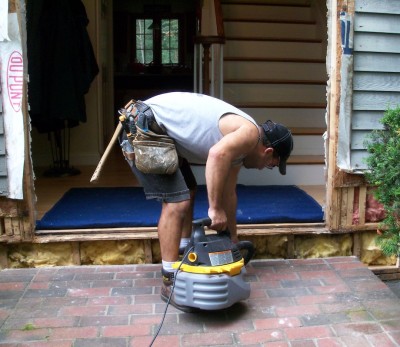 |
And Now for the Existent Job
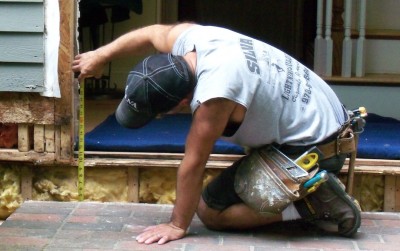 | I began by taking iii measurements for my width (middle and both ends), and I went with the smallest i simply to be certain the joist would fit. |
| Then I measured for my length, and cutting the joist near an eighth smaller. Doing this immune me to slide in the rim joist very hands. | 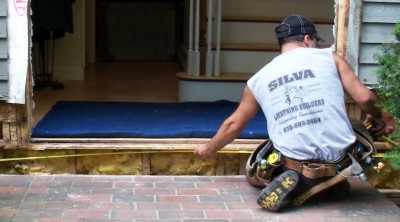 |
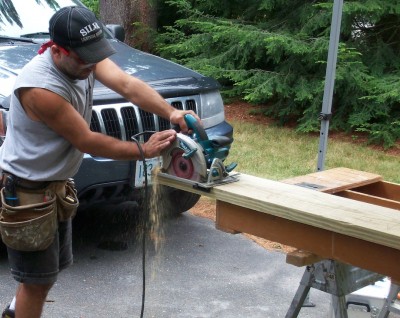 | I ripped downwardly and cut to length a slice of pressure-treated lumber. I always seal any fresh cuts with a good wood preservative before installing a rim joist. |
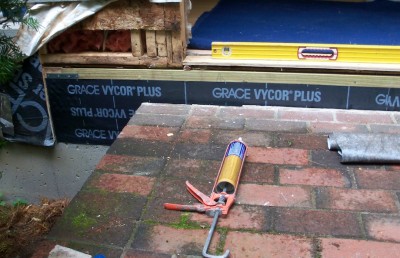 Subsequently tapping in the rim joist, and securing it to the floor joists, I added metal plates to tie the repaired section to the existing rim joist. Since the stoop was placed up confronting the rim joist, I too added a piece of self-adhesive flashing to protect the structure. This important detail was previously missing, and information technology contributed to the h2o damage.
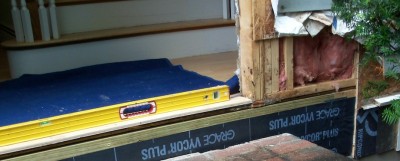 | Installing self-adhesive flashing helps forestall any further rot to the rim joist. I was sure to go out a space of about 1/4 in. between the stoop and rim joist to allow for futurity drainage. |
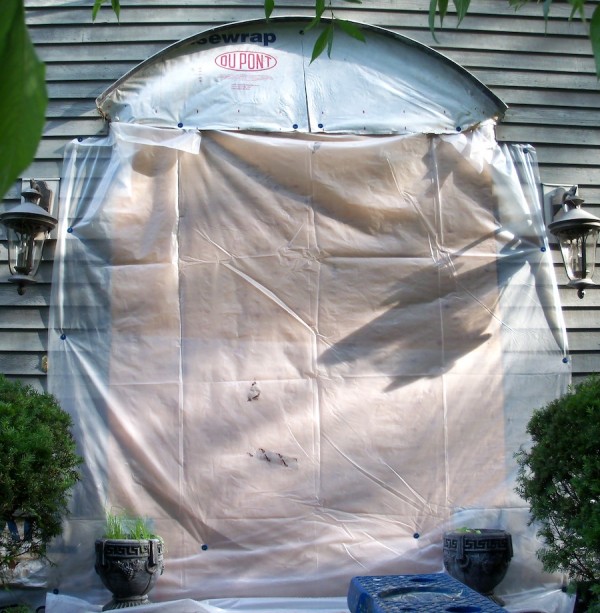
As a side notation, I always make sure to keep my long projects weather condition-tight and secure, no matter what the forecast says! You don't desire to have any problems that could force you to pay for damages. Trust me.
| I ran continuous beads of exterior-grade adhesive to the rim joist and studs. | 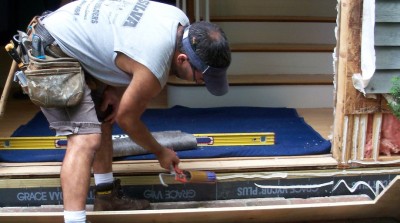 |
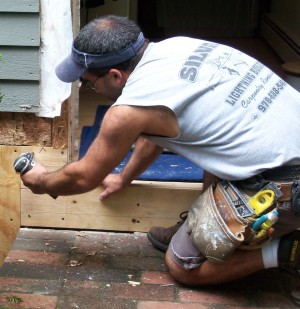 | I and so installed new, 1/two-in. sheathing, which I cutting to fit around the stoop. I left well-nigh 1/4 in. of a gap and then that the capsule wouldn't rot, and to let for proper drainage. |
| I besides added 1/2-in. sheathing to the jambs to human action as spacers. | 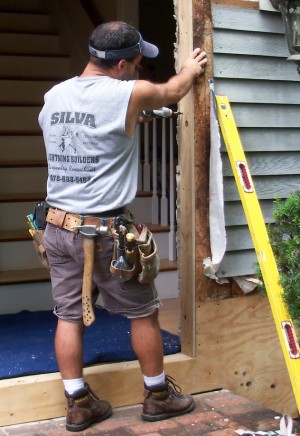 |
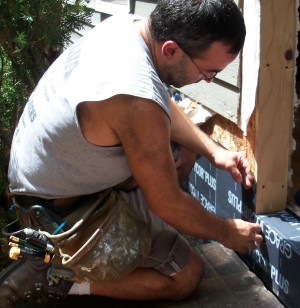 | I applied self-adhesive flashings in order to brand the door opening watertight. |
| I started with the sill, and followed past adding corner flashings to each corner—these are called "bow ties" (see photo, right). | 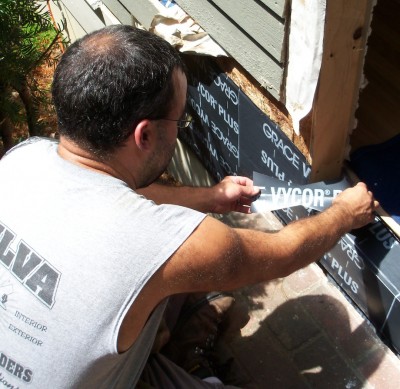 |
And so I installed both sides, repeating the aforementioned process at the tiptop of the opening with more bow ties.
Instead of installing the unit of measurement into the opening and fussing with wood shims, I opted for a unlike approach. This different mode made it easier, faster, and immune me to work solitary. I used deck screws as shims on each side to make my unit of measurement dead-plumb with no fussing.
First, I marked the location of the hinges onto the crude opening, and I marked the location of the top and bottom of the unit. Starting from the sill on the opening, I marked a eye line in the eye, and then measured half the distance both means to the outside dimension (O.D.) of the jamb—that's where I'd start installing "shim screws". I installed a pair of "shim screws" at each location, keeping them apartment and spaced enough to catch the jamb's width.
I began the shimming process from the lesser. I measured up 1 in. from the bottom location on the jamb, and I installed a pair of screws. To know how deep to set the screws, I set my speed square apartment on the sill and held it on the mark I'd made for the O.D. of the jamb. I adjusted the screws until they touched the square. I prefer to use a spiral gun rather than an impact—screw guns make information technology easier to gear up the screws. Once the bottom screws were set, I installed the next gear up of screws plumb to the bottom screws using a 2-ft. level. I connected in this manner upward the jamb, using each previous set of screws equally a starting point. Once I reached the top, I added a set of screws one inch below the top of the door unit.
When I completed the jamb side, I transferred all the screw locations to the other side and pre-set those screws. Then, I cut a lath to the exact dimension of the door unit. Using this board as a guide, I ready the screws across from each other to fit the board. The opening was then ready to receive the door unit of measurement.
Re-installing the Entry Door
I always like to attempt to fit the door into the opening, just and so I can be sure information technology fits before I lay beads of caulking on the sill and secure the unit.
| In this case, the door fit perfectly. But at that point, I realized that I didn't pre-drill holes into the jambs to secure the door! I made sure not to striking the shim screws. I and so pre-prepare all the screws. | 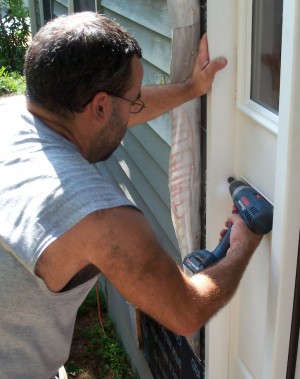 |
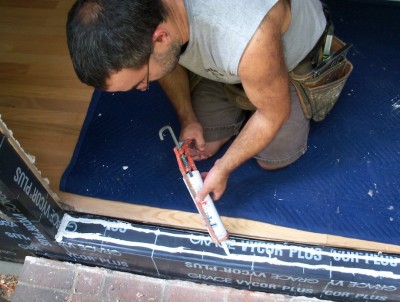 | I ran ii beads of sealant to the sill. This would assist prevent water and drafts from entering. It would also help to cease whatsoever squeaks between the threshold and sill. |
| Installing a single door unit is a one-person chore, but having ane with sidelites requires an extra pair of hands. Nosotros dropped the unit into the opening, making sure the sill and fresh beads of caulking made a good seal. Then we tilted the unit into place. | 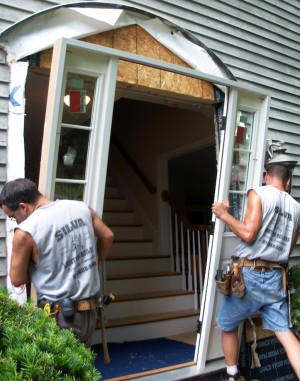 |
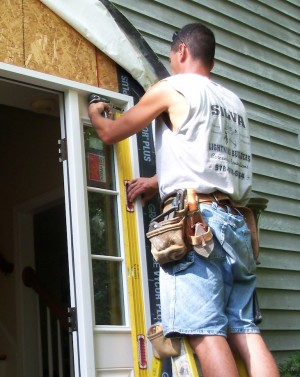 | Before securing the unit, we used a level to check for plumb, and we also made certain the unit was plumb off the house. This last function is very important so that the door doesn't swing in either direction past itself. |
Exterior Trim
I pre-assemble all my exterior trim, and I do it right on the jobsite. I use a small portable DeWalt table saw to rip the casing to width, and so it will fit perfectly between the jamb and the siding.
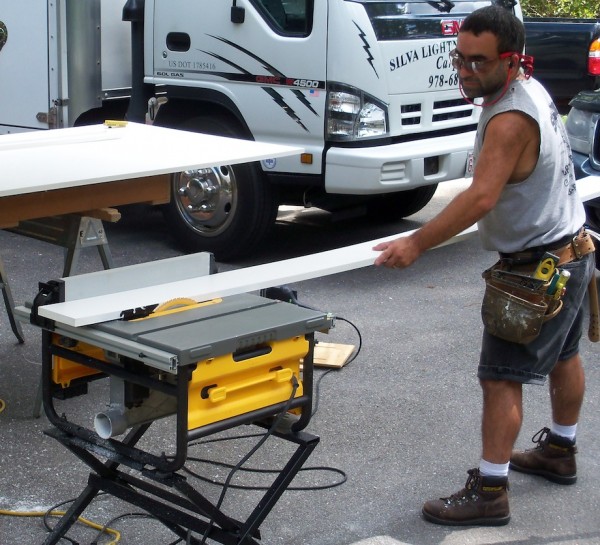
| I exit the casing legs long so I tin use them as a story pole to lay out the entablature details—that includes the astragral molding, the frieze, and the crown. | 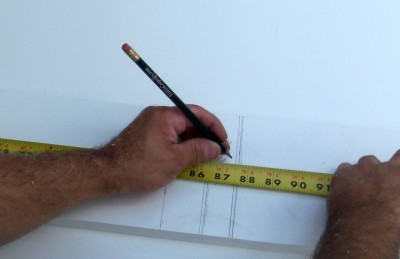 |
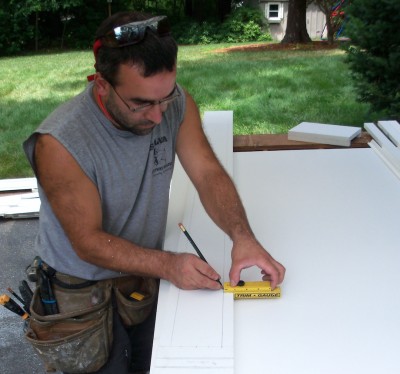 | On this job, I wanted to match the fluting to the original casing, so I laid out the flutes using a Trim Gauge. I similar this tool a lot. It rides smoothly on the edge of a lath, and information technology's easy to adjust for unlike reveals. |
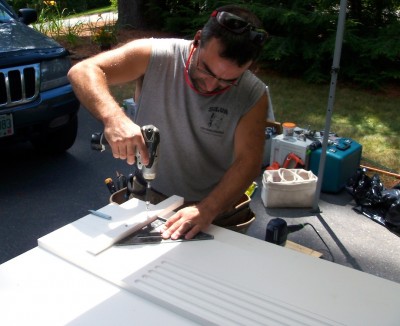 | To stop all the flutes so the tops are perfectly straight, I adhere a temporary finish to the casing leg. This is a pretty fool-proof system, and it's fast. |
| With the sled fix and stops on both pieces of casing, I can run four flutes, one on each leg, for both the within and the exterior flutes, then accommodate the sled to cutting the inside flutes. | 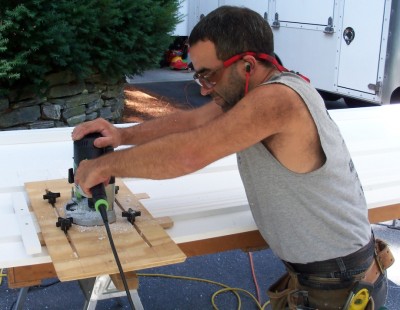 |
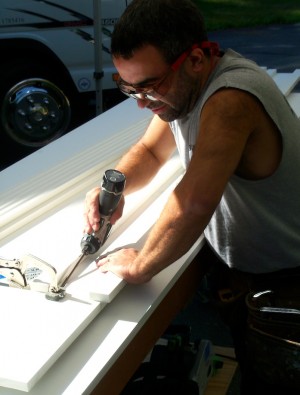 | I pocket spiral the legs to the frieze, and gum that joint, also. |
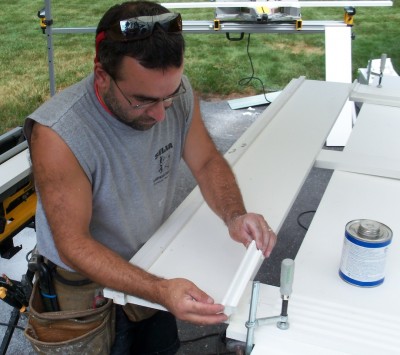 Then I install the astragal moldings, which I likewise pre-assemble then that the miters are tight. The weather tin be brutal where I alive, deep freezing in the winter and loftier humidity in the summer, then I utilise PVC trim whenever possible—that way I never accept to worry virtually coming dorsum to a job for repairs. PVC isn't affected by moisture content, only temperature. And with PVC cement, the miters are joined molecularly. I never have to caulk annihilation.
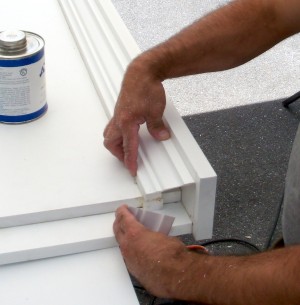 | And another thing about PVC trim: I can sandwich countless pieces on meridian of each other without worrying nigh moisture getting trapped between the pieces and causing rot—later all, that's why the people hired me in the outset place, to fix the rot! |
| I build upwards the frieze from two boards, then wrap the crown molding around the top lath so it terminates confronting the backboard, which makes it easy to butt into the existing siding. Just like the astragal molding, I start past cutting the miters and dry-fitting the pieces, then I pre-gather the miters earlier attaching the crown. | 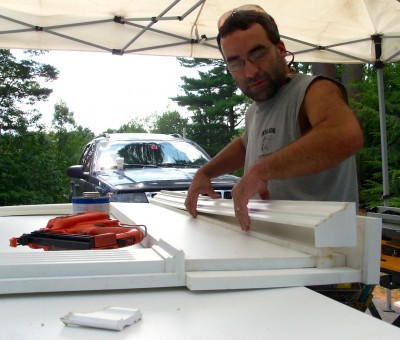 |
Final Flashing
Subsequently securing the door unit into the opening, information technology was time to apply the outer layer of wall flashing.
We started from the lesser and worked our way up to the top, overlapping each piece past vi inches. In social club to prevent moisture from entering backside the siding, we needed to seal the wall flashing to the housewrap.
| This is where nigh leaks start, and they tin create serious rot due to improper sealing of the housewrap to the wall flashing. I applied the wall flashing to the door jamb, nearly ane/2 in. in from the edge of the jamb, leaving more a 1/4-in. reveal. The dorsum of the flashing lapped over the housewrap about two in.—this was to ensure that no moisture or water will enter the opening. | 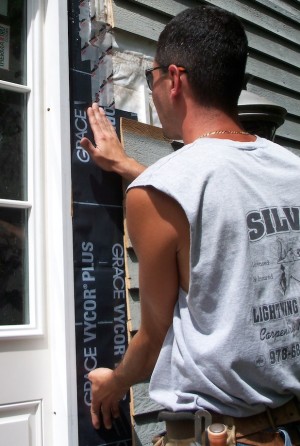 |
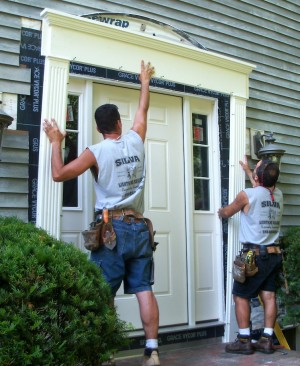 | Since I pre-assembled my exterior trim as a unit, and made sure to measure correctly, installation was fast and accurate. Once nosotros tilted the trim kit in place and checked the fit, it was set up to be attached. |
We secured the trim kit to the door and wall sheathing, making sure the head and side casings were plumb and level. I similar to utilise screws rather than nails, because then I can be confident that the trim will stay secure, and that the joints will remain tight for years.
I installed a piece of flashing before adding the pre-assmbled plinth blocks. This flashing would help reduce any water from entering behind the stoop. I sealed the top edge of the flashing with housewrap record, and left the bottom edge open for h2o to drain out.
Flashing the Head
I don't own a brake, simply sometimes I wish I did—especially for custom trim like the deep entablature above this door. I needed a piece of aluminum bent, and I wasn't going to hire a brake for only one piece! Then I decided to brand a jig from a scrap piece of plywood, and I fastened that to my worktable.
I measured out 2 lines ninety degrees to each other for the lengths I needed. Each line's measurement equaled the exact width of the slice of flashing. Using my jigsaw, and a very steady hand, I cut each line to its exact distance. If the cuts were off, I wouldn't exist able to make the piece I wanted. I had to be certain my cuts were perfect.
| Once my cuts were done, I simply curled the slice of flashing, inserting one corner first, and slowly forming the piece into the jig until both outer edges of flashing—along with the within edge—were in the jig about an inch. Then it was simply a affair of pulling the piece of flashing through the jig, and forming the slice of flashing I needed. | 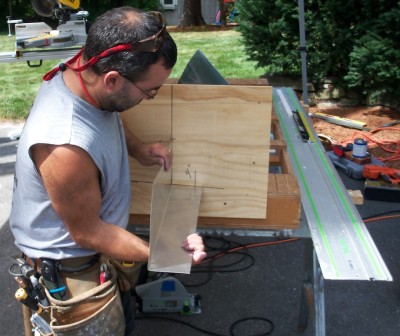 |
 | I secured the flashing above the head using builder'due south record. I could have used another slice of Vycor, but I figured the housewrap would also cover the acme leg of the flashing. |
| After the metal flashing was secured, I pulled the housewrap back down and trimmed information technology to fit. I then tied in the siding. | 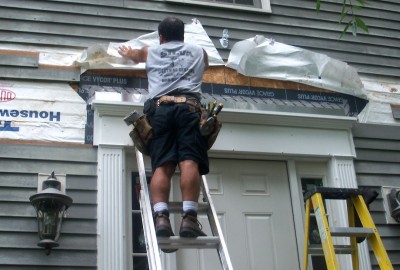 |
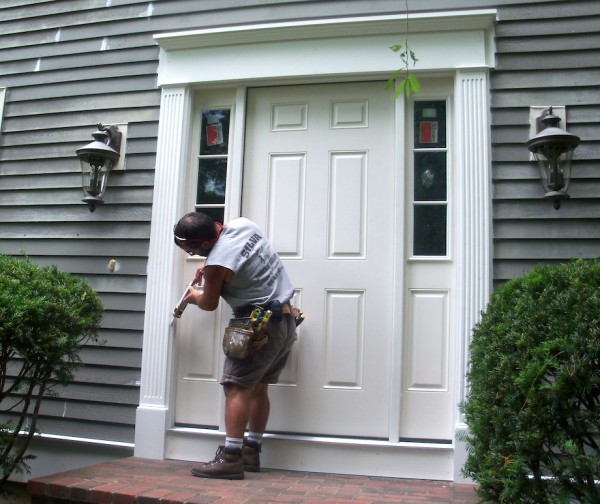
Before leaving, I caulked a few joints to be sure the door was complete and ready for the homeowner to pigment (over again).



0 Response to "How To Repair A Rotten Door Threshold"
Post a Comment